Resources

LFJL Urgently Needs your Support

Lawyersfor Justice in Libya depends on your support! Your donation will makea huge difference and help ensure we can continue to work on promotehuman rights and pursue accountability on the ground in Libya.

Our Mission and Values

Our Mission

Established in 2011, LFJL is a Libyan and international human rights non-governmental organization that pursues transformative and holistic justice to create systemic change. We challenge the underlying social, cultural, economic, ecological and political conditions that give rise to injustice, corruption, and violence in Libya. Our belief is that challenging these root causes will transform lives and bring justice to those inside and outside the country. Our beneficiaries are the people of Libya, be they in country or in the diaspora, and people suffering from violations and crimes committed in Libya.

Our Vision

LFJL’s vision is a peaceful and stable Libya that embodies the values and principles of human rights, is free from conflict and division, and where a functioning rule of law and strong institutions allow all people in Libya to live in safety and dignity.

How We Work

In 2024, LFJL underwent a restructuring to respond to rapidly changing political realities in which human rights and multilateralism are increasingly undermined. Going against ‘business as usual’, this shift challenges traditional human rights work, aiming for tangible, transformative change.

Prioritising the voices of victims
Focusing on real impact on daily lives
Solidarity with the Libyan people
Bottom-up approach

Movement Building

to ensure a strong and resilient civil society working towards transformative justice. We support, strengthen and work with civil society organisations, activists and human rights defenders across Libya to establish an independent, vibrant and resilient civil society at the grassroots as well as local and national levels. We work with civil society actors to build movements on a broad range of issues pertinent for Libya’s transformation towards the respect for the rule of law and with strong institutions.

01
  • FJL’s flagship Civil Society Academy (CSO Academy) - our bespoke training programme providing the tools to enable CSOs of all kinds to set up and professionalise. Through the CSO Academy, we strengthen the capacity and effectiveness of civil society activists and change-makers to build and develop organisations, enhancing their ability to advocate for democracy, human rights, gender equality and the rule of law.

  • LFJL’s Adala Academy (adala = justice in Arabic), the first Arabic language e-learning platform dedicated to human rights, featuring easily accessible training materials and expert video tutorials, helps deliver tailored, specialised and technical training for CSOs and human rights experts on issues ranging from documentation, case building,  SGBV investigations to advocacy and campaigning.

  • Our Mentorship Programmer sees pioneering Libyan activists come to LFJL’s London office for two months to collaborate with our team and facilitate exchanges and develop a network with human rights activists from other countries and regions.

  • Creation of a Women, Peace and Security (WPS) working group, a dedicated platform for women led organisations promoting information sharing, strategic coordination and active participation in Libya's political processes supported by a self-sufficient secretariat that responds to our partner's needs.

Daily injustices and institutional change

to uphold people’s dignity. We focus our activities on root causes and social inequalities that contribute to undermining peoples’ dignity in daily life. Complementing our more traditional engagement of human rights that strengthens civil and political rights we focus on issues that currently prevent people in Libya, including in particular from marginalised communities, from leading dignified lives, including access to citizenship, corruption, and realisation of their economic and social rights. Through our vast network across Libya, we are in a position to shed light on systemic failures and daily injustices across Libya to pursue systemic change.

02
Our projects and activities in this area include:
  • Campaigning and advocating for the rights and demands of residents of Derna, following the collapse of two dams in Derna in 2023, and examining how corruption and institutional failure contribute to and exacerbate inequality.

  • Collaborating with partners and experts in and outside Libya to raise awareness about the costs of corruption on Libyans’ daily lives, the implications of corruption on their enjoyment of human rights such as the right to education and the right to health, and strengthening institutional anti-corruption institutions and frameworks.

Accountability and Justice

to end impunity and provide redress to victims. Together with partners, we strategically engage domestic, regional and international accountability and justice mechanisms to combat the culture of impunity, the absence of justice for victims and build an accountability and justice mindset.

03
Our work in this area includes:
  • Documentation of human rights violations and serious international crimes committed in Libya, with all documentation preserved in our Justice and Accountability Archive and Database.

  • Establishing and facilitating a Coalition for the Rights of Victims of serious international crimes committed in Libya. The coalition supports and advocates for the rights of victims, including before the International Criminal Court to strengthen the Court’s transformative impact on Libya’s justice system, victims and affected communities.

  • Overcoming constraints of traditional accountability and advocacy methods within existing international and national frameworks, LFJL’s “Accountability & Justice Hub” nurtures creative solutions to intractable problems and supports new approaches and thinking that engage with the idea of changing a flawed system of working outside of it.

Equality and Non-Discrimination

as a cornerstone of a just society. We aim to identify and address intersectional factors that impact the realisation of justice in Libya through anti-racist, feminist and anti-colonial approaches.

04
Examples of our work in this area include:
  • Collaborating with, including through sub-granting to, women’s rights groups in Libya, to support their sustainability, strengthen their effectiveness and to build stronger, more sustainable teams and deepen trust within their communities.

  • Launch of a regional dialogue on Online Violence against Women (OVAW), bringing together women advocates to discuss OVAW and develop concrete recommendations directed at technology companies, civil society organisations and states.

  • Support of rights of migrant and refugee victims of abuses and crimes committed in Libya through campaigning, advocacy and strategic litigation. This also includes cooperation with and support of relevant mechanisms and initiatives to identify and disrupt human trafficking networks in Libya and its neighbouring countries

Our Alliance

LFJL’s Designed Team Alliance (DTA) has been developed by LFJL staff and members of the Board of Trustees. It is designed to guide our relationship with each other and with our partners, to establish trust and alignment, and it sets expectations and lays out key values to which everyone agrees and has input.

Respect

The commitment to our work and cause involves demonstrating consideration for and valuing our abilities, as well as equally respecting the individuals we collaborate. That entails respecting boundaries, time, ideas, and engaging in constructive disagreement.

Safety

Team psychological safety embodies a collective belief among team members that it is acceptable to take risks, express ideas, and concerns, ask questions, and admit mistakes without fear of negative consequences. This translates into cultivating an environment that is supportive, constructive, and fosters positive collaboration.

Trust

The commitment to mutual good faith, reliability, and confidence in the abilities of others.

Accountability

The commitment to taking responsibility for our work, with all team members pledging to hold each other accountable for Alliance norms, address breaches or issues constructively, take personal responsibility for actions, and actively listen to feedback.

Constructive and Honest Communication

The commitment to conveying one's perspective and feedback with clarity and integrity and a constructive approach.

Empathy

The commitment to conveying one's perspective and feedback with clarity and integrity and a constructive approach.

Where we Work

LFJL has offices and staff in London, Tunis and Tripoli and works with a network of long-term partners across Libya including in Tripoli, Benghazi, Misrata, the Western Mountains, Bani Walid and Sabha. We work across SWANA, Europe, Africa and beyond to identify, disrupt and hold to account those responsible for human trafficking networks and support migrant and refugee victims of human trafficking and related crimes committed in Libya.

Our Team

LFJL’s Designed Team Alliance (DTA) has been developed by LFJL staff and members of the Board of Trustees. It is designed to guide our relationship with each other and with our partners, to establish trust and alignment, and it sets expectations and lays out key values to which everyone agrees and has input.
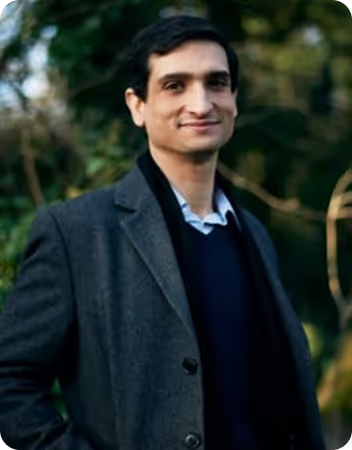
Ghazi Gheblawi is a Libyan physician, author, blogger, and activist. He studied medicine in Tripoli and holds a MBBch (Bachelor in Medicine) and Msc (Master of Science in medicine) degrees. Since 2002, he has lived in Britain, where he writes frequently about the situation in Libya. In 2004, he co-founded the Libya Alyoum (Libya Today) online newspaper and served as cultural editor until 2009. He also produced and hosted the Imtidad cultural podcast which focuses on literature and arts in Britain and the Arab world.

Ghazi Gheblawi

Trustee

Ghazi Gheblawi

Trustee

Fayruz Abdulhadi joined the LFJL Board of Trustees in 2023 and was appointed Chair of the Finance Committee. Fayruz is Managing Director at HSBC, where she deputises for the Global Financial Controller in matters of accounting and financial reporting, oversees controllership for the Group’s holding companies, service companies and mergers and acquisitions, and acts as the CFO for the bank’s Corporate Centre. Over the past 14 years, Fayruz has held numerous roles at HSBC spanning financial control.

Fayruz Abdulhadi

Chairperson

Fayruz Abdulhadi

Trustee

Andrew Balfour has been a member of LFJL’s Board of Trustees since 2012 and was appointed Chairperson in 2017. Andrew is a solicitor and former partner at Slaughter and May. Prior to his retirement as a partner in 2011, Andrew was Head of Financing and a member of the Partnership Board. His practice, with over 30 years at Slaughter and May, covered a wide range of corporate and financing work, including UK privatisations, mergers and acquisitions, financing transactions, as well as transactions in Africa. Andrew sits on the boards of a number of charities and is a Governor of a school in London.

Andrew Balfour

Chairperson

Andrew Balfour

Chairperson

Mariam Elhadri is a co-founder of LFJL and joined the Board of Trustees in 2014. Mariam currently works as a Legal Manager at TOTAL in Libya. In the past Mariam worked for LFJL in multiple capacities, including Fundraising and Communications Officer and Coordinating Officer, where she worked on fact finding alleged human rights violations in Libya in the period since 15 February 2011.

Mariam Elhadri

Trustee

Mariam Elhadri

Trustee

Mervet Mhanni joined the Board of Trustees in 2017. Mervet is a Libyan activist and senior member of the non-partisan and highly respected Free Generation Movement (FGM) that was a significant part of the 2011 resistance in Tripoli. Through FGM’s Mafqood project and later at the Ministry of Martyrs and the Missing, Mervet worked extensively on the search for missing persons in Libya.

Mervet Mhanni

Trustee

Mervet Mhanni

Trustee

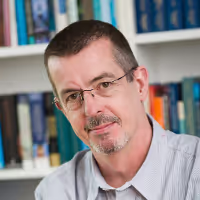
Dr. Lutz Oette was one of LFJL’s earliest supporters and has given legal and strategic advice to LFJL over the years, as well as training lawyers and activists at LFJL workshops and collaborating on anti-torture work. Lutz joined the Board of Trustees in 2017. Outside of LFJL, he is the LLM Human Rights, Conflict & Justice and MA Human Rights Law Convenor, and the Director of the Centre for Human Rights Law at SOAS, University of London. Before taking up his post at SOAS full time, Lutz combined teaching and research with his role as Counsel at REDRESS, an international human rights organisation that helps torture survivors obtain justice and reparation.

Lutz Oette

Trustee

Lutz Oette

Trustee

Carla Ferstman is a Canadian qualified barrister and solicitor with a wealth of experience in human rights law and international criminal law. She is currently a Senior Lecturer at the University of Essex Law School. Over the years, Carla has worked at a variety of organisations, including the Office of the United Nations of the High Commissioner for Human Rights in Rwanda and Amnesty International in London. She also worked at REDRESS, first as Legal Director and then as Director from 2004-2018. Under her leadership, REDRESS won the MacArthur Foundation Award for Creative and Effective Institutions. In 2012/13, while on sabbatical from REDRESS,

Karla Ferstman

Chairwoman

Karla Ferstman

Chairwoman

Professor Ali Abdullatif Ahmida was born in Libya and attended Cairo University in Egypt and the University of Washington, Seattle. He was founding Chair of the Department of Political Science at the University of New England, Maine, U.S. His areas of expertise are political theory, comparative politics, and historical sociology focusing on power, agency, genocide, and anti-colonial resistance in North Africa, specifically Libya. Mr. Ahmida is a respected author of an array of scholarly literature.

Ali Abdullatif Ahmida

Board Member

Ali Abdullatif Ahmida

Board Member

Ignacio Saiz is an international human rights expert and activist specialising in the links between human rights and economic justice. He currently works as an advisor to the Office of the United Nations High Commissioner for Human Rights, to leading international human rights NGOs such as Amnesty International, and to foundations working at these intersections. Ignacio served for twelve years as Executive Director of the Center for Economic and Social Rights (CESR), a pioneering international NGO working for a rights-based economy, and formerly served as Director of Policy for Amnesty International. He received an LLM in International Human Rights Law

Ignacio Saiz

Board Member

Ignacio Saiz

Board Member

Professor Youssef Sawani is a Libyan political scientist, analyst and author. He began his career at the University of Tripoli in 1985 as a member of faculty. He became the Head of the Department of Political Science in 1989 and in 1998, and the Coordinator of Graduate Programme in 2004. He has 38 years of teaching and research experience and between 2016-22 was the editor of the Contemporary Arab Affairs Journal published by the University of California Press. Between 2012-21, he assumed leading roles at the Center for Arab Unity Studies in Beirut including that of the Acting Director-General and Director of Studies.

Youssef Sawani

Board Member

Youssef Sawani

Board Member

Amal Hadi is an independent gender consultant and human rights activist. Previously she worked as a Project Officer at Oxfam, Egypt, and as a Women’s Program Coordinator at the Cairo Institute for Human Rights Studies (CIHRS) until 1998. Before becoming a gender consultant, Amal worked as a Coordinator at New Woman Foundation, an Egyptian non-governmental organisation that targets women empowerment and women’s rights. She holds a degree in Medicine and Surgery form Ain Shams University, and a diploma in Industrial Medicine. She also graduated from Rutgers University, New Brunswick, in 2000, with a degree in Women Studies.

Amal Hadi

Board Member

Amal Hadi

Board Member

Hassan Al Amin is a Libyan activist and advocate working to expose human rights abuses and promote democracy in Libya. Hassan fled Libya for the UK in 1983 after Muammar Gaddafi’s security forces arrested and beat him. From London he founded the independent website Libya al-Mostakbal (The Future Libya). Hassan returned to Libya during the revolution in 2011 and won a parliamentary seat in Libya’s first democratic elections in 2012. However, in 2013 he was forced to return to London as a result of his work investigating the mistreatment and torture of prisoners by anti-Gaddafi armed groups. In 2013, he received the Human Rights Watch’s Alison Des Forges Award

Hassan Al Amin

Board Member

Hassan Al Amin

Board Member

Laila Alodaat is a Syrian human rights lawyer specialised in international law of armed conflicts and the human rights of women with 15 years of experience in litigation, advocacy and governance. She holds a BA in Law and an LLM in Human Rights, Conflict and Justice, and is a qualified trainer of international humanitarian law. Laila is currently the Deputy Secretary General of the Women’s International League for Peace and Freedom (WILPF) and sits on the board of trustees of the Feminist Review Trust.

Laila Alodaat

Board Member

Laila Alodaat

Board Member

Tim Eaton is a Senior Research Fellow with the MENA programme at Chatham House, where he focuses on the political economy of the Libyan conflict. In 2018 Tim authored a report on the development of Libya’s war economy, in which he examined the increasing connection between economic activities and violence. Prior to this, Tim managed Chatham House’s research on the Syrian conflict, including its ‘Syria and its Neighbours’ policy initiative. Previously Tim worked for BBC Media Action, the BBC’s international development charity, on projects in Iraq, Egypt, Tunisia and Libya.

Tim Eaton

Board Member

Tim Eaton

Board Member

Asma Khalifa is a Libyan activist and researcher, and is co-founder of the Tamazight Women’s Movement (TWM). TWM is an intersectional feminist think tank conducting research on, and advocating for, the indigenous women of Libya and North Africa. Its work currently focuses on strengthening the resilience of civil society organisations working on women, youth, peace and security. Asma’s previous research has included work on governance and development indicators for Libya and gendered communication patterns in the Middle East and North Africa. In 2016 Asma was awarded the Luxembourg Peace Prize during the World Peace Forum.

Asma Khalifa

Board Member

Asma Khalifa

Board Member

Ian Martin is a British human rights activist and and former United Nations official. His work in international NGOs has included being Secretary-General of Amnesty International, Vice President of the International Center for Transitional Justice, and Executive Director of Security Council Report.  His senior United Nations capacities have included Special Representative of the Secretary-General (SRSG) in East Timor (1999) and Nepal (2007-2009), as well as the first SRSG for Libya (2011-2012). He has also served in human rights or peace operations in Haiti, Rwanda, Bosnia and Herzegovina, and Ethiopia/Eritrea.

Ian Martin

Board Member

Ian Martin

Board Member

Hisham Matar is a British-Libyan writer. He is a Fellow of the Royal Society of Literature and an Associate Professor of Professional Practice in Asia & Middle East Cultures, Comparative Literature, and English at Barnard College, Columbia University. His first novel, In the Country of Men, was shortlisted for the Man Booker Prize and won numerous literary awards, including the Commonwealth Writers’ Prize Best First Book award for Europe and South Asia, the Royal Society of Literature Ondaatje Prize, and the inaugural Arab American Book Award. His memoir, The Return, published in 2016, won the 2017 Pulitzer Prize for Biography or Autobiography.

Hisham Matar

Board Member

Hisham Matar

Board Member

Tarek Megerisi is a Libyan political analyst and researcher who specialises in Libyan affairs and more generally politics, governance and development in the Arab world. He is currently a Visiting Fellow at the European Council on Foreign Relations in London. He started his career in Tripoli with the Sadeq Institute, Libya’s first independent think tank, where he  worked as a Research Fellow for Political Affairs. He also worked as a consultant on Libya’s transition with various NGOs, collaborating with a range of international experts on issues of democratisation and constitutionalism to directly assist Libya’s new institutions.

Tarek Megerisi

Board Member

Tarek Megerisi

Board Member

Hajer Sharief is a Libyan activist and co-founder of the non-profit organisation Together We Build It. Her organisation works on the democratic transition in Libya by emphasising the relevance of women's and youth participation in the political process. In 2013 she co-initiated the 1325 Network in Libya, a network of civil society organisations encouraging women to play an active role in peacebuilding and conflict prevention. She is also an advocate for Kofi Annan Foundation with the Extremely Together initiative on countering violent extremism and a member of the UN Advisory Group of Experts for the Progress Study on Youth, Peace and Security. In 2017,

Hajer Sharief

Board Member

Hajer Sharief

Board Member

Lynn Welchman is Professor of Law at the School of Oriental and African Studies in London, where she teaches Law and Society in the Middle East and North Africa, Human Rights and Islamic Law, and the International Human Rights Clinic. Before starting her academic career, Lynn worked on human rights in the Arab world for 15 years working mostly with Palestinian organisations including Al Haq but also with international NGOs including Amnesty International, Human Rights Watch and the International Federation for Human Rights Leagues. She is also a member of the founding editorial board of the Muslim World Journal of Human Rights.

Lynn Welchman

Board Member

Lynn Welchman

Board Member

Iain Scobbie is a British expert in public international law. He is currently the Chair of International Law at University of Manchester Law School and a Senior Teaching Fellow at the School of Oriental and African Studies (SOAS) in London. He was previously the Sir Joseph Hotung Research Professor in Law, Human Rights, and Peace Building in the Middle East at SOAS, where he taught the law of armed conflict. Iain maintains a special interest in international humanitarian law; international adjudication, particularly the role of the International Court of Justice; and in the theory of international law. He is on the International Advisory Council of Diakonia's International Humanitarian Law

Iain Scobbie

Board Member

Iain Scobbie

Board Member

Chloe Dennis is Advisor to LFJL’s Board of Trustees and supports its finance team. She works on LFJL’s governance, grants and development. Chloe was previously the Director of Operations at LFJL from 2017 until 2022, having first joined in 2014 as an intern. In another life, she would have been an architect.

Chloe Dennis

Advisor

Chloe Dennis

Advisor

Cristina Orsini is Senior Programmes Advisor at LFJL. Previously, Cristina worked with Defend Defenders and the Pan-African Human Rights Defenders Network in Uganda, UNICEF Algeria, and the Unrepresented Nations and Peoples Organisations in the Netherlands. She is currently a researcher in international law at the European University Institute. She is happiest surrounded by good food, nature and friends.

Cristina Orsini

Senior Programme Advisor

Cristina Orsini

Senior Programme Advisor

Elham Saudi is co-founder and Executive Director of LFJL. Since establishing LFJL in 2011, she has advised several Libyan, European and international bodies in relation to the conflict in Libya and international law. More recently, she was a member of the panel presiding over the Iran Atrocities (Aban) Tribunal in November 2019.  Elham is an unapologetic fan of reality television.

Elham Saudi

Executive Director

Elham Saudi

Executive Director

Farah Abou El Sel is the Ali Nouh Fund Coordinator at LFJL, where she oversees an emergency fund dedicated to supporting Libyan human rights defenders facing imminent threats. Prior to joining LFJL, Farah developed grants management and donor relations for humanitarian and human rights projects in various contexts, notably Syria and Lebanon, Fluentin five languages and currently learning a sixth, she is also apassionate cat lover and rescuer.

Farah Abou El Sel

Ali Nouh Fund Coordinator

Farah Abou El Sel

Ali Nouh Fund Coordinator

Fatou Kane is the Finance and Human Resources Director at LFJL. She has over 15 years of experience leading in finance, within the human rights and NGO field, including at Reprieve as Head of Finance, and the Diana Award as Finance Manager. She is a passionate consumer of African television series.

Fatou Kane

Finance and Human Resources Director

Fatou Kane

Finance and Human Resources Director

Jürgen Schurr is the Director of Programmes at LFJL. He was previously the Head of Law at LFJL and worked for a range of NGOs, and as a consultant for the African Commission on Human and Peoples’ Rights and the United Nations. He is a struggling long-distance runner.

Jürgen Schurr

Director of Programmes

Jürgen Schurr

Director of Programmes

Marwa Ben Abderrazek is Senior Strategic Gender Advisor, heading LFJL’s Women, Peace, and Security (WPS) work, drawing on extensive experience in media, human rights, and advocacy for women's rights across North Africa. With previous roles at the British Embassy Libya, Avocats Sans Frontières, and the Institute for War and Peace Reporting, Marwa combines strategic insight with hands-on expertise in gender, WPS, program management, MEL, and grants. Fluentin three languages, Marwa is a dedicated voice for WPS and genderjustice. She is known for her lively discussions about Tunisianculture; expect to find her passionately sharing stories of herTunisian favourite dishes like Couscous, and Harissa.

Marwa Ben Abderrazek

Senior Strategic Gender Advisor

Marwa Ben Abderrazek

Senior Strategic Gender Advisor

Mehdi Ben Youssef is Programmer Lead atL FJL. In this role, Mehdi is leading a programmer on pursuing accountability for serious international crimes and gross human rights violations in Libya. He previously worked as a Regional Campaigner at Amnesty International, documenting and launchingcampaigns on human rights violations in Libya and Tunisia . Heloves Indian food and is happiest outdoors, whether on a hike orenjoying time in nature.

Mehdi Ben Youssef

Programme Lead

Mehdi Ben Youssef

Programme Lead

Rawia Hamza is Senior Programmes Advisor at LFJL, where she coordinates LFJL’s relationships and activities with partners and stakeholders in Libya. She first worked with LFJL as a partner in 2016 through the Tamkeen for People with Disabilities organisation. Rawia speaks Urdu, thanks to her lifelong love for Bollywood.

Rawia Hamza

Senior Programmes Advisor

Rawia Hamza

Senior Programmes Advisor

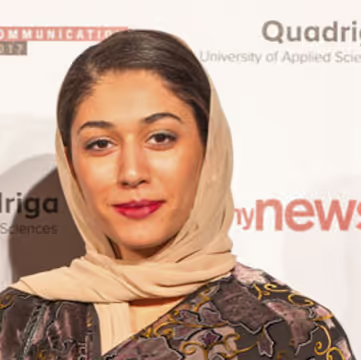
A Bader is a Communications Advisor at LFJL, contributing her expertise to the organization's communication efforts. With a background in design and architecture, she has a deep love for art and creativity. Prior to LFJL, she served as a Senior Designer Consultant at different NGOs and initiatives, blending her passion for design with social impact. Outside of work, Bader enjoys good food, good music, and endlessly rewatching the same sitcoms.

A.Bader

Communications Advisor

A. Bader

Communications Advisor

Resources

Contact Us

If you have any questions, comments or concerns, please reach out to us using this form or the email address below.

info@libyanjustice.org
Thank you! Your submission has been received!
Oops! Something went wrong while submitting the form.